
India has a protein problem. And most people living with it have no idea.
A 2017 survey conducted by the Indian Market Research Bureau found that approximately 80% of Indian households consume inadequate protein. This isn’t a statistic about poverty or food scarcity. It cuts across income groups, urban households, and educated demographics. People eating three full meals a day are still protein deficient because the meals themselves are structurally low in protein.
Understanding why this happens and what it costs the body over time, is one of the most important conversations in Indian nutrition today.
What Is the Daily Protein Requirement?
The Indian Council of Medical Research recommends a minimum of 0.8 to 1 gram of protein per kilogram of body weight per day for a sedentary adult. For someone who is physically active, managing a chronic condition, or above the age of 40, that requirement increases to 1.2 to 1.6 grams per kilogram.
For a 60 kg woman, that translates to 48 to 60 grams of protein daily at minimum and up to 96 grams if she is active or managing conditions like PCOD, thyroid dysfunction, or insulin resistance.
Most Indians consume between 25 and 40 grams per day. The gap is significant.
Why Is the Indian Diet So Low in Protein?
The structure of a typical Indian meal is rice or roti as the base, with dal, sabzi, and a small portion of curd or paneer. It’s predominantly carbohydrate-heavy. Dal is often consumed in quantities too small to meaningfully contribute to daily protein targets. Protein sources like eggs, fish, and meat are excluded from a large vegetarian population. And plant-based protein sources, while present, come with absorption challenges due to phytates and anti-nutrients that reduce bioavailability.
The result is a diet that feels complete and satisfying but is chronically under-delivering on one of the body’s most critical macronutrients.
What Protein Deficiency Actually Costs the Body
The consequences of long-term protein deficiency are rarely dramatic in the short term which is precisely why they go unaddressed for years.
Muscle loss and metabolic slowdown— Protein is the primary building block of muscle tissue. Inadequate intake accelerates the natural muscle loss that begins after age 30, slowing resting metabolic rate and making weight management progressively harder over time.
Persistent fatigue and poor recovery — Enzymes, hormones, neurotransmitters, and immune cells are all protein-dependent. Low protein intake compromises energy production, immune response, and the body’s ability to repair itself after physical or psychological stress.
Hair fall and skin deterioration — Keratin, collagen, and elastin — the structural proteins responsible for hair strength, skin integrity, and nail health are among the first to be compromised under chronic protein deficiency.
Hormonal imbalance — Hormones including insulin, thyroid hormones, and reproductive hormones are synthesized from amino acids. Insufficient dietary protein directly impairs hormonal production and regulation — a factor frequently overlooked in the clinical management of PCOD, thyroid dysfunction, and metabolic disorders.
Impaired immunity — Antibodies are proteins. A protein-deficient body produces fewer and weaker immune responses, making seasonal illness, slow wound healing, and frequent infections more likely.
High Protein Indian Foods Worth Including Daily
Building a high protein Indian diet does not require eliminating traditional foods or relying on supplements. It requires redistribution, i.e., increasing the proportion of protein-dense foods within existing meal frameworks.
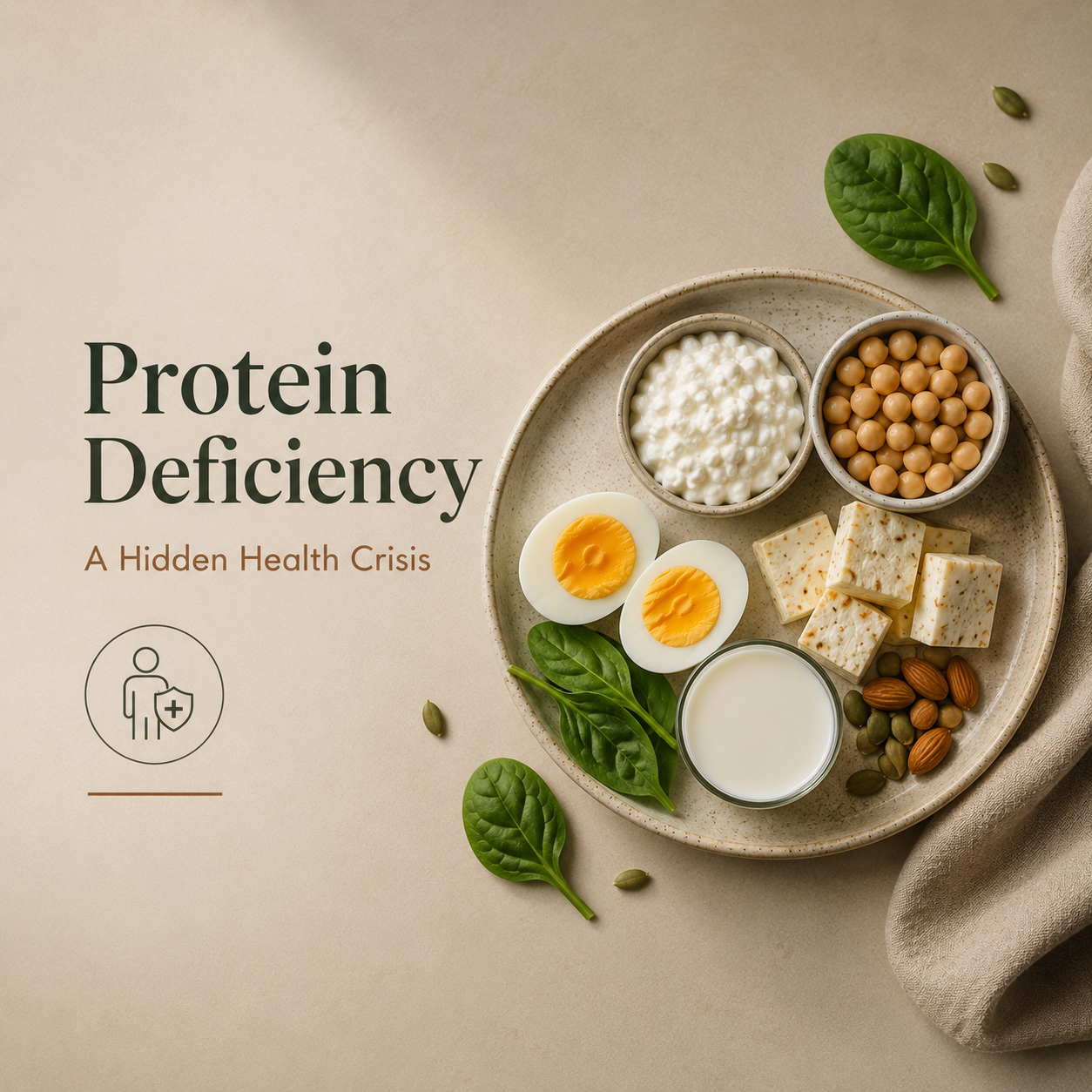
Eggs offer the highest biological value protein available in whole-food form. Paneer, curd, and low-fat dairy are practical vegetarian sources. Moong dal, chana, rajma, and soya chunks provide plant-based protein in quantities that can meaningfully contribute when consumed in adequate portions. Fish and chicken remain the most bioavailable animal protein sources for non-vegetarians. Pumpkin seeds, hemp seeds, and roasted chana serve as effective high-protein snack replacements for processed alternatives.
The goal is simple: at least one significant protein source at every meal, not as a side, but as a central component.
The Bottom Line
Protein deficiency in India is not a niche clinical problem. It is a widespread, largely invisible nutritional gap that quietly drives fatigue, weight gain, hormonal imbalance, hair loss, and poor immunity across millions of households.
The fix does not require expensive supplements or dramatic dietary overhauls. It requires awareness of what adequate protein actually looks like on a plate, and what it costs the body when it’s consistently missing.
📍 Dr. Abhijit’s Easydiet Clinic & Kure | Salt Lake, Kolkata For personalised dietary assessment and meal planning — visit www.drabhijitsdietclinic.com or call +91 8100254153