
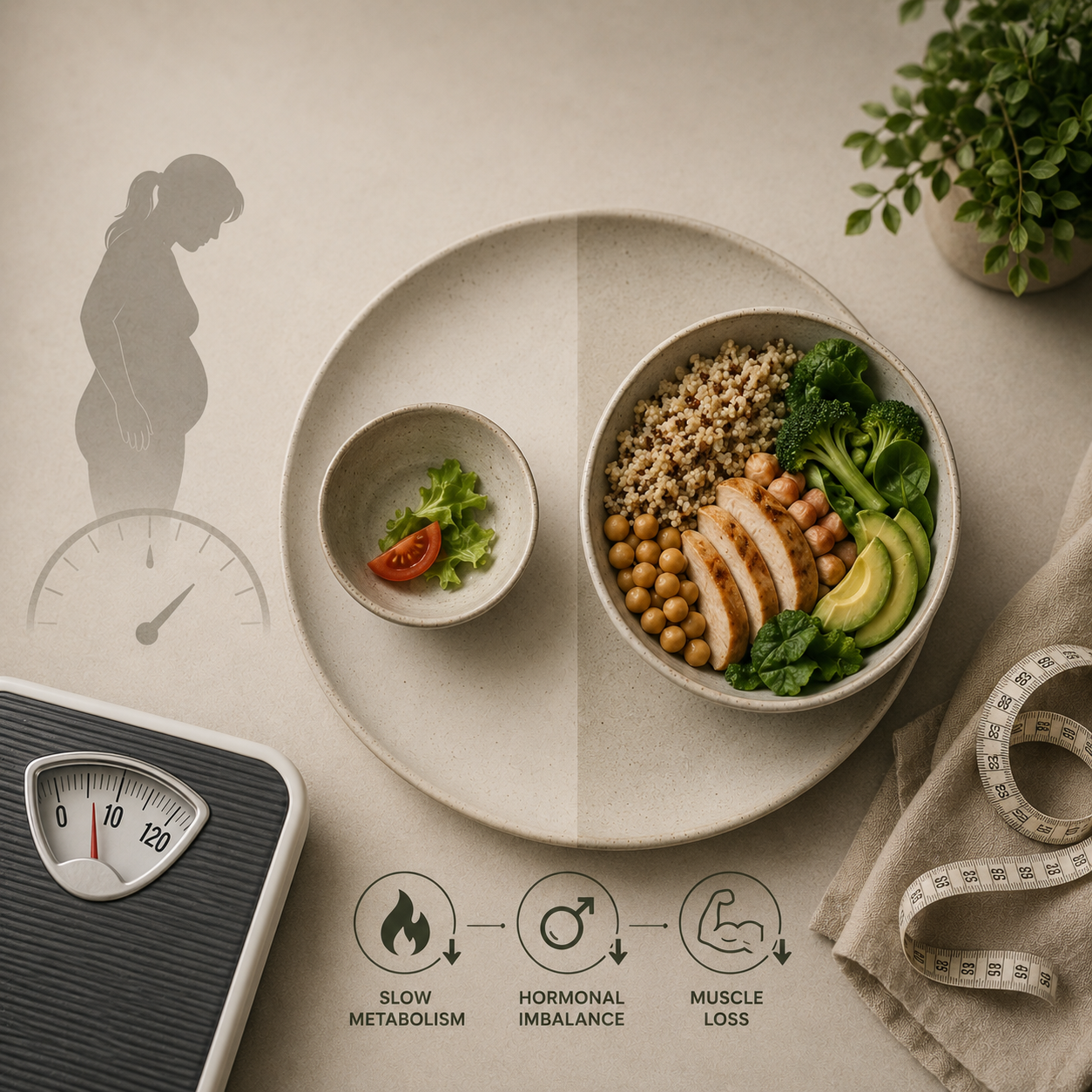

You reduced your portions. You cut out rice at night. You stopped snacking. And somehow — the weight is still going up, or stubbornly refusing to move.
If this sounds familiar, you are not imagining it. And you are not failing at your diet.
What you are experiencing has a biological explanation — one that the calorie-counting model of weight management completely fails to account for.
The Calorie Deficit Myth
The dominant weight loss narrative for the last five decades has been built on one equation: eat less than you burn, and you will lose weight. It is simple, logical, and largely wrong — at least as a complete explanation.
The human body is not a calculator. It is a hormonal system. And when that system detects sustained caloric restriction, it responds — not by burning stored fat efficiently, but by defending its current weight through a series of biological adaptations that most people have never been told about.
This response is called adaptive thermogenesis. And it is the primary reason why eating less often stops working.
What Happens When You Eat Less
Within days of significant caloric restriction, the body initiates a survival response. Resting metabolic rate — the number of calories the body burns at complete rest — begins to decline. Research shows that prolonged caloric restriction can reduce resting metabolic rate by 20 to 30 percent. This means the body learns to function on fewer calories, effectively closing the deficit that was supposed to produce weight loss.
Simultaneously, hunger hormones shift. Ghrelin — the hormone that signals hunger — increases significantly during caloric restriction and remains elevated for months, even after weight loss stops. Leptin — the hormone that signals fullness and regulates metabolic rate — drops. The result is a body that is hungrier, burning fewer calories, and hormonally primed to regain weight at the first opportunity.
This is not weakness. This is physiology.
The Muscle Problem
Caloric restriction without adequate protein and resistance activity causes the body to break down muscle tissue for energy alongside fat. This is metabolically catastrophic in the long term.
Muscle is the primary driver of resting metabolic rate. Every kilogram of muscle burns approximately 13 calories per day at rest. Every kilogram of fat burns roughly 4. As muscle mass declines through repeated cycles of restriction, the body’s baseline calorie requirement drops further — making future weight management progressively harder.
This explains a pattern seen in chronic dieters — each successive diet produces less weight loss than the previous one, and weight returns faster each time. The muscle lost through restriction is never fully recovered, and the metabolic rate never fully rebounds.
Insulin — The Hormone Calorie Counting Ignores
Beyond metabolic adaptation, there is a second mechanism that eating less completely fails to address — insulin.
Insulin is the body’s primary fat storage hormone. When insulin is elevated, fat burning is suppressed — regardless of how few calories are being consumed. Refined carbohydrates, frequent snacking, and high sugar intake keep insulin chronically elevated throughout the day. In this hormonal environment, the body cannot access stored fat for energy even when it is calorically restricted.
This is why someone eating 1200 calories of biscuits, white rice, and packaged food will not lose fat — while someone eating 1600 calories of protein, vegetables, and complex carbohydrates often does. The calories are different. The insulin response is completely different. And insulin determines the outcome.
What Actually Works
Sustainable fat loss requires a fundamentally different approach than eating less.
Adequate protein intake — a minimum of 1 gram per kilogram of body weight — preserves muscle during a calorie deficit, supports metabolic rate, and keeps hunger hormones regulated. Protein has the highest thermic effect of any macronutrient, meaning the body burns more calories simply digesting it.
Meal composition matters more than meal size. Building meals around protein and fibre first — before carbohydrates — naturally moderates insulin response, extends satiety, and reduces total calorie intake without the metabolic penalties of deliberate restriction.
Meal timing supports metabolic function. Eating the majority of calories earlier in the day aligns food intake with peak insulin sensitivity — improving glucose utilisation and reducing fat storage regardless of total calorie intake.
Consistency over restriction. The body responds to patterns, not individual meals. A moderate, sustainable dietary approach maintained consistently outperforms aggressive restriction followed by inevitable rebound — every single time.
The Bottom Line
Eating less is not a weight loss strategy. It is a short-term intervention with long-term metabolic consequences when applied without the right nutritional framework.
Weight gain despite eating less is not a personal failure. It is a predictable biological response to an approach that was never designed to work permanently.
The body does not need to be starved. It needs to be fed correctly.
📍 Dr. Abhijit’s Easydiet Clinic & Kure | Salt Lake, Kolkata
For a personalised dietary assessment — visitwww.drabhijitsdietclinic.comor call +91 8100254153